The Village I Won't Burn Down
Jul 20, 2026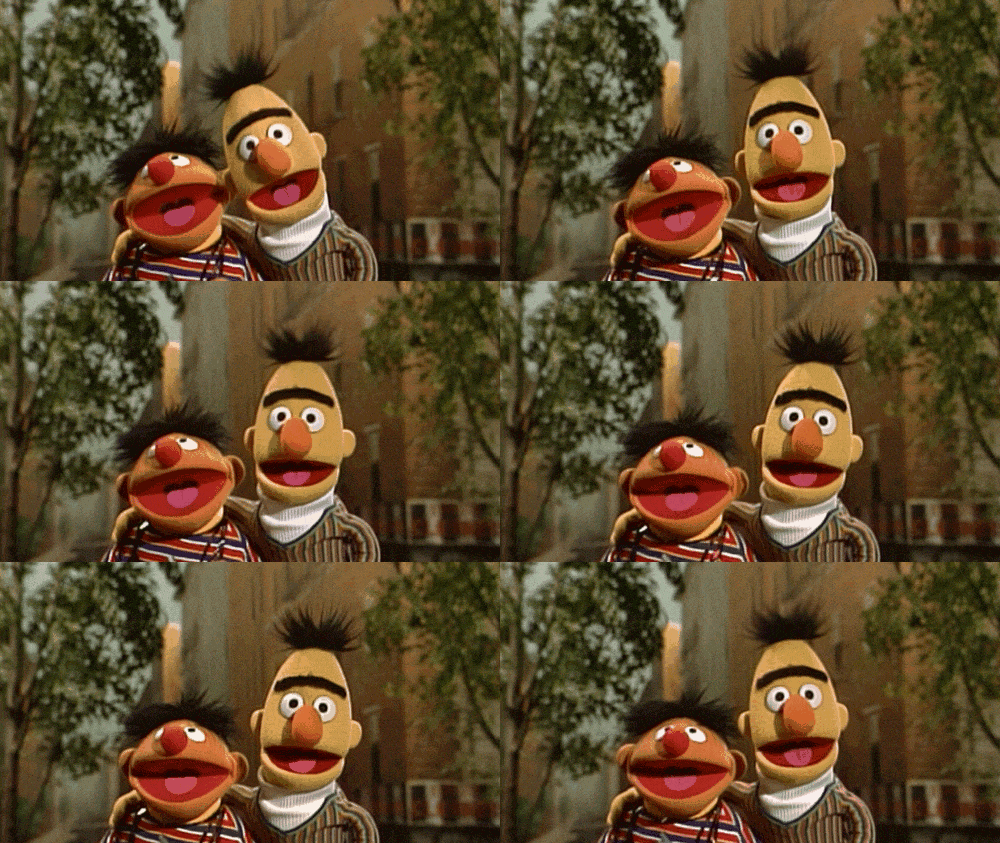
On antibiotics, a lifetime of sophisticated sensitivity, and the gut I've spent years learning to tend
I have a bug. A small, ordinary, uninvited houseguest situation. The polite version is that I picked up something that's going around. The honest version, which I prefer, is that I have other people's shit in my shit. I've named them Bert and Ernie. They are not welcome, exactly, but they're here.
And here is the thing everyone wants to say to me — gently, lovingly, and fast: just take the antibiotics.
My mastermind group said it. Kind, smart people who care about me. Oh, I'd totally get antibiotics. And I understand the philosophy completely. I do. It's a reasonable thing to say to a person who's uncomfortable. Hand that same advice to almost anyone else and I'd probably nod along.
But it landed in me and didn't quite fit, and I've learned to pay attention to the things that don't quite fit. So let me tell you why.
I've learned to pay attention to the things that don't quite fit.
I was, according to my father, sophisticated. That was his word for it. I grew up allergic to the planet — the kind of system that reads ordinary pollen and dust and scent as a threat and mounts a full defense: the mucus, the sneezing, the streaming eyes, the histamine flood. And the hives. Welty, itchy, crazy-making patches that traveled across my skin without warning for decades. My body was not malfunctioning. It was vigilant. It was a sophisticated early-warning system doing exactly what a sophisticated early-warning system does — maybe a little too well.
Then came the asthma. It arrived in my thirties and it was not gentle. Four inhalers a day. Nebulizer treatments more times than I want to count. Steroids and prednisone, more or less constantly — bronchitis that lasted for months, the booster shots, the whole grim carousel. There was a stretch where I was on a serious dose of prednisone for weeks, and then I landed in the hospital, and my body, flooded with all of those foreign substances, reacted the only way it knew how. It tried to push everything out. Histamine everywhere. It was, as I sometimes say, threat management on crack.
I don't tell you this for sympathy. I tell it to you because it's the ground the rest stands on.
Because somewhere in the middle of all of that, I began to understand that my asthma wasn't only in my lungs. It was downstream of my gut. Years of inflammatory eating had injured the lining, and the injury was showing up as breath I couldn't catch. Researchers are still working out exactly how these threads connect — how much the repeated courses of antibiotics, the disrupted internal ecosystem, shaped the allergies and the asthma that came after. The evidence there is emerging, not settled, and I try to hold it that way: as an honest wondering, not a verdict. But I don't need a finished study to know what I lived. I lived the connection. I felt it in my own chest.
So I got to work. Not on a diet — on repair. I have done so many specific, intentional healing protocols over the years to tend, gently, to this internal landscape. Some of them gentle. Some of them not remotely gentle. One or two I would never in a hundred years recommend to another living soul. I pulled the things that inflamed me. I rebuilt the fiber, the good populations, the architecture. I've been careful — deliberately, patiently careful — for years now. My asthma has been quiet, missing from my daily life, for a long, long stretch. These days I even have a little help rebuilding the gut wall itself, a bacterium that emerging research suggests can do what most probiotics can't.
I built a village. That's honestly how I think of it. A whole living population I tended by hand, over years, through my father's death and my mother's dementia and every ordinary and extraordinary stress a life can hold. I know these little ones. I adore them — the sweet, industrious ones, and even the occasional purple minions who wander in wanting sugar and drama. I adore the whole messy population.
I built a village. A whole living population I tended by hand, over years.
Which is why, when someone says just take the antibiotics, what I hear — for me, in my particular body, with my particular history — is: walk into a village of beautiful, lovely people and splay the whole thing with fire.
I don't want to do that. Not for Bert and Ernie. Not for a houseguest situation that everything I've read tells me is uncomfortable but not dangerous — that comes and goes, that will run its course. I would rather host the discomfort for a few days, or even a few weeks, than torch the thing I spent a decade rebuilding. So I'm drinking my gallon of water. I found an unflavored electrolyte powder that helps enormously. I'm living on soup, tended by my oldest, who hates cooking for me because of everything she has to leave out. And I'm watching. Carefully. Closely.
Now — please hear this part, because it matters more than any of the rest.
This is not medical advice. I am not telling you to refuse antibiotics. Antibiotics are important. Antibiotics are necessary. Antibiotics save lives — including, at various points, versions of mine. If my body tells me this has turned into something that needs them, I will go get them without a moment's hesitation, and I'll be grateful they exist. I am paying attention precisely so that I can make that call the instant it needs making.
What I'm describing isn't a rule. It's a sacred boundary — and there's a difference. A rule is something handed to you, obeyed out of fear, rigid whether or not it fits. A boundary is something you choose, from knowing, with your eyes open and your body consulted. Everyone should avoid antibiotics would be a rule, and a bad one. I, with this history, this ecosystem, this level of attention, get to be extra careful with this particular treatment — that's a boundary. It bends when it needs to. It's mine.
And underneath all of it is the thing I keep coming back to — the thing I'll probably be saying until I'm done saying anything at all: my body was never broken. Not the hives, not the asthma, not the vigilance, not the sophisticated, over-defended system I was born into. It was paying attention to real signals. It still is. The most loving thing I can do is pay attention right back.
Bert and Ernie will move on. The village will still be standing.
With love and light,
Sonja
Stay connected with news and updates!
Join our mailing list to receive the latest news and updates from our team.
Don't worry, your information will not be shared.
We hate SPAM. We will never sell your information, for any reason.